Access Control in RAG with Pinecone and SpiceDB
Available onOpen SourceCloudDedicatedEnterpriseRetrieval-Augmented Generation (RAG) systems combine the power of vector search with large language models to answer questions using your organization’s data. However, without proper authorization controls, these systems can leak sensitive information across organizational boundaries.
This guide shows how to implement fine-grained, relationship-based authorization in RAG pipelines using SpiceDB and Pinecone - a fully managed, cloud-native vector database designed for fast similarity searches at scale. By integrating SpiceDB’s permission checks directly into your retrieval workflow, you ensure that users only receive answers based on documents they’re authorized to access.
Why Authorization Matters in RAG
Standard RAG pipelines retrieve documents based purely on semantic similarity, without considering user permissions. This creates critical security vulnerabilities that the OWASP Foundation identifies as Top 10 risks for LLM applications .
The risks include:
- Sensitive Information Disclosure: Users may receive answers containing data from unauthorized documents
- Excessive Agency: Actions to be performed in response to unexpected, ambiguous or manipulated outputs from an LLM
- Vector embedding weaknesses: Embeddings themselves can encode sensitive information
Consider a common scenario: your company stores both public marketing documents and confidential financial reports in the same vector database. Without authorization, an entry-level employee asking “What was our Q4 revenue?” might receive an answer derived from executive-only financial documents—even if the employee never had direct access to those files.
Authorization isn’t just about blocking document access after retrieval. It must be enforced throughout the entire RAG pipeline to prevent information leakage through embeddings, metadata, and generated responses and that’s where SpiceDB comes in. Read more about ReBAC, Google Zanzibar, and SpiceDB here .
Intro to SpiceDB
SpiceDB stores access relationships as a graph, where nodes represent entities (users, groups, documents) and edges represent relationships (like “viewer,” “editor,” or “owner”). Fundamentally, authorization logic can be reduced to asking a single question:
Is this actor allowed to perform this action on this resource?
In SpiceDB parlance, this actor and this resource are both Objects and this action is a Permission or Relation. Here’s a Google Docs style example where a user can be either a reader or a writer of a document. A reader can only read the document, whereas a writer can read and write the document.
You can represent this use case using a schema like this:
definition user {}

definition article {
    relation viewer: user
    relation editor: user

    permission view = viewer + editor
    permission edit = editor
}
In this model, articles have two relations: viewer (users who can read) and editor (users who can modify).
The view permission is granted to anyone in either relation, while edit requires the editor relation.
Relations define direct relationships between objects, while permissions compute who has access based on those relations. You cannot write relationships directly to permissions—only to relations.
Authorization Strategies: Pre-Filter vs Post-Filter
There are two primary approaches to enforcing authorization in RAG pipelines. Each has distinct trade-offs based on your document corpus size, user access patterns, and performance requirements.
Pre-Filter Authorization
Pre-filter authorization queries SpiceDB before searching the vector database. You first ask SpiceDB “which documents can this user access?” and then retrieve only those authorized documents.
How it works:
- Call SpiceDB’s
LookupResourcesAPI to get all document IDs the user can access - Use those IDs to filter the Pinecone query (via metadata filtering)
- Only authorized documents are retrieved and embedded in the LLM context
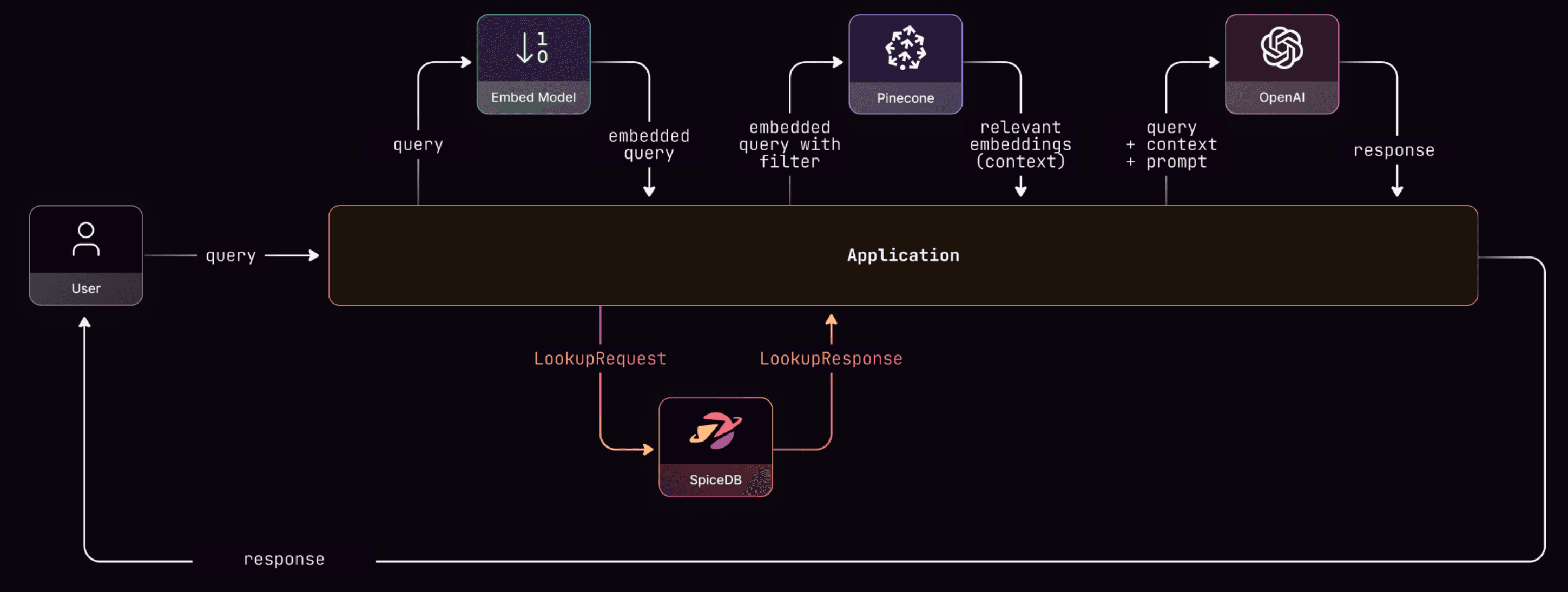
Code example:
from authzed.api.v1 import Client, LookupResourcesRequest, SubjectReference, ObjectReference

# Query SpiceDB for authorized document IDs
client = Client("spicedb.example.com:443", bearer_token)

subject = SubjectReference(
    object=ObjectReference(object_type="user", object_id="alice")
)

response = client.LookupResources(
    LookupResourcesRequest(
        resource_object_type="article",
        permission="view",
        subject=subject
    )
)

authorized_article_ids = [r.resource_object_id async for r in response]
# Result: ['123', '456', '789']

# Use authorized IDs to filter Pinecone query
from pinecone import Pinecone
pc = Pinecone(api_key="your-api-key")
index = pc.Index("documents")

results = index.query(
    vector=query_embedding,
    filter={"article_id": {"$in": authorized_article_ids}},
    top_k=10,
    include_metadata=True
)
When to use pre-filter:
- Large document corpus with hundreds of thousands or millions of documents
- Users typically have access to a small percentage of total documents
- Low retrieval hit-rate (most searches return few relevant documents)
- You want predictable authorization overhead independent of search results
Trade-offs:
- More computationally expensive per authorization check (must enumerate all accessible documents)
- Authorization latency scales with the number of documents a user can access
- Highly efficient when users have narrow access (e.g., team-specific documents)
Post-Filter Authorization
Post-filter authorization retrieves documents from Pinecone first, then filters results through SpiceDB permission checks.
How it works:
- Query Pinecone normally to retrieve semantically relevant documents
- Extract document IDs from the results
- Call SpiceDB’s
CheckBulkPermissionsAPI to verify which documents the user can access - Filter out unauthorized documents before passing to the LLM
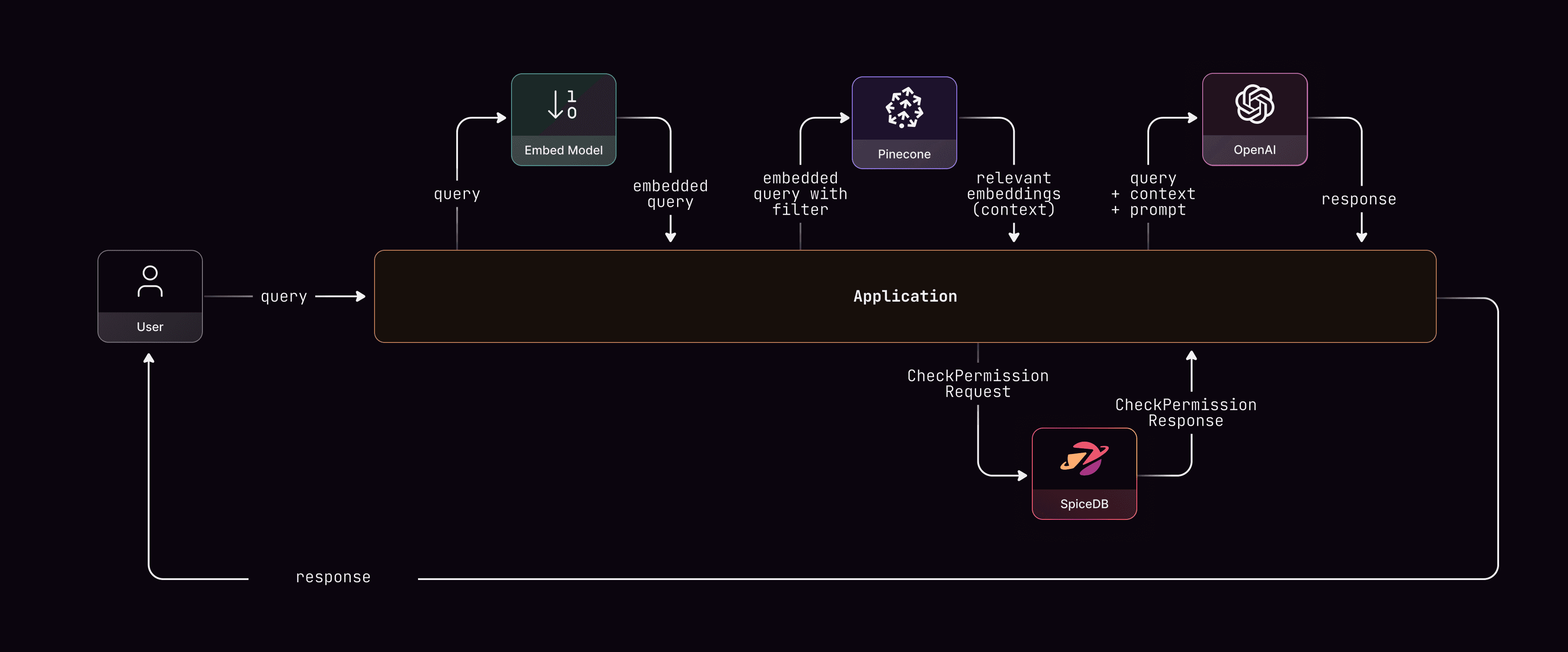
Code example:
from authzed.api.v1 import Client, CheckBulkPermissionsRequest, CheckBulkPermissionsItem
from authzed.api.v1 import SubjectReference, ObjectReference, Relationship

# First: Retrieve documents from Pinecone
from pinecone import Pinecone
pc = Pinecone(api_key="your-api-key")
index = pc.Index("documents")

results = index.query(
    vector=query_embedding,
    top_k=20,  # Fetch more than needed to account for filtering
    include_metadata=True
)

# Second: Check permissions for each retrieved document
client = Client("spicedb.example.com:443", bearer_token)

check_items = [
    CheckBulkPermissionsItem(
        resource=ObjectReference(
            object_type="article",
            object_id=match["metadata"]["article_id"]
        ),
        permission="view",
        subject=SubjectReference(
            object=ObjectReference(object_type="user", object_id="alice")
        )
    )
    for match in results["matches"]
]

permission_response = await client.CheckBulkPermissions(
    CheckBulkPermissionsRequest(items=check_items)
)

# Third: Filter to only authorized documents
authorized_documents = [
    match for match, pair in zip(results["matches"], permission_response.pairs)
    if pair.item.permissionship == CheckBulkPermissionsResponseItem.PERMISSIONSHIP_HAS_PERMISSION
]
When to use post-filter:
- Smaller document corpus
- High search hit-rate (most retrieved documents are relevant)
- Users typically have broad access to documents
- You want to maintain optimal vector search quality
Trade-offs:
- Requires over-fetching documents to ensure you have enough after filtering
- Authorization latency scales with number of search results (not total corpus)
- More efficient when users have broad access patterns
Related Resources
For deeper exploration of SpiceDB and RAG authorization:
- LangChain-SpiceDB Official Library : Post-filter authorization library for LangChain and LangGraph
- Secure RAG Pipelines Repo & Workshop : A hands-on self-guided workshop covering both pre-filter and post-filter techniques using Pinecone and Langchain
- Pinecone Documentation : Official Pinecone vector database documentation